

How Do Egg Cooker Heating Systems Influence Cooking Consistency?
2026-10-16
A product manager for a small appliance brand runs a kitchen test with three Egg Cooker units from the same production batch. Each unit is filled with the same amount of water, loaded with six large eggs from the same carton, and set to the medium setting. The first unit produces eggs with a firm white and a creamy yolk. The second unit produces eggs with a slightly runny white. The third unit produces eggs with a fully set yolk. The difference is not the eggs. It is the heating system. The heating element power, the thermal contact between the element and the water, and the steam distribution all affect how consistently the eggs cook. This guide explains the relationship between heating system design and cooking consistency.
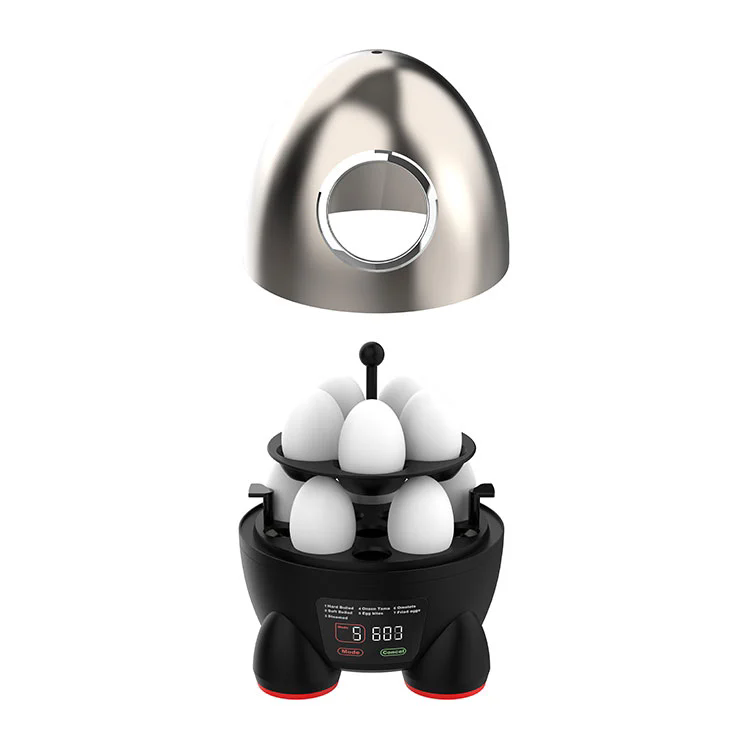
1. What Are the Different Heating Systems Used in Egg Cookers?
There are three common heating systems in an Egg Cooker: the exposed coil heater, the cast aluminum plate heater, and the steam generator with a PTC element. Each has a different heat transfer mechanism and a different level of consistency. The exposed coil heater transfers heat primarily by radiation and convection. The cast aluminum plate heater transfers heat by conduction through the plate to the water. The PTC steam generator transfers heat by conduction to a small amount of water, which produces steam that circulates around the eggs. The table below compares the three systems.
| Heating system | Heat transfer method | Power range | Temperature uniformity | Typical consistency |
| Exposed coil heater | Radiation + convection | 300 – 500 W | Moderate | ±3°C variation |
| Cast aluminum plate heater | Conduction to water | 350 – 600 W | Good | ±1.5°C variation |
| PTC steam generator | Conduction + steam circulation | 200 – 400 W | Excellent | ±0.5°C variation |
In our factory, we manufacture Egg Cooker units with all three heating systems. The PTC steam generator provides the best consistency because the steam surrounds the eggs uniformly and the temperature is controlled by the PTC element's self-regulating characteristic. The cast aluminum plate is a good compromise between cost and performance. The exposed coil is the least expensive but also the least consistent. Foshan TEH Electric Appliance Co., Ltd. has been manufacturing egg cookers for over 12 years.
2. How Does Power Density Affect the Cooking Rate and Consistency?
The power density is the wattage per unit area of the heating element. A higher power density heats the water faster, but it can also create hot spots that cause uneven cooking. A lower power density heats more gently and evenly. The optimal power density depends on the volume of water and the number of eggs. For a six-egg cooker with 150 ml of water, the optimal power density is 4 to 6 W/cm². The table below shows the relationship between power density and cooking consistency.
| Power density (W/cm²) | Heat-up time (minutes) | Hot spot risk | Cooking consistency |
| 2 – 3 | 8 – 10 | Low | Good |
| 4 – 6 | 5 – 7 | Moderate | Very good |
| 7 – 9 | 3 – 5 | High | Moderate |
| > 10 | < 3 | Very high | Poor |
Product manager's note: A higher power density does not always mean better performance. In our kitchen tests, a 500 W coil heater with a power density of 8 W/cm² produced eggs with inconsistent yolk consistency. The water boiled too vigorously, and the eggs bounced against each other, causing cracks. A 350 W plate heater with a power density of 5 W/cm² produced eggs with consistent texture and no cracks. The power density must be matched to the water volume and the egg capacity.
3. How Does Temperature Control Affect Protein Coagulation?
Egg proteins coagulate at specific temperatures. The yolk begins to thicken at 65°C and becomes fully set at 70°C. The white begins to set at 60°C and becomes fully firm at 80°C. The difference between a runny yolk and a hard-boiled egg is only a few degrees. The temperature control system in the Egg Cooker determines whether the eggs are cooked to the desired doneness. A simple thermostat with a fixed setpoint may overshoot or undershoot. A PID controller with a temperature sensor can maintain the water temperature within ±1°C. The table below shows the relationship between temperature control and egg doneness.
| Temperature control | Water temperature range | Yolk result | White result |
| Fixed thermostat | 95 – 100°C | Fully set (hard) | Firm |
| Adjustable thermostat | 75 – 95°C | Soft to hard | Soft to firm |
| PID controller | 60 – 100°C ± 1°C | Precise control (soft, medium, hard) | Precise control |
In our factory, we use a PID controller with a thermistor sensor in our premium Egg Cooker models. The controller maintains the water temperature within ±1°C of the setpoint. This allows the user to select soft, medium, or hard doneness with repeatable results. The table below shows the recommended temperature setpoints for different doneness levels.
| Doneness level | Water temperature setpoint | Cooking time | Yolk consistency |
| Soft-boiled | 65°C | 6 – 7 minutes | Runny |
| Medium-boiled | 70°C | 8 – 9 minutes | Creamy |
| Hard-boiled | 80°C | 10 – 12 minutes | Fully set |
4. What External Factors Affect Cooking Consistency?
Even the best heating system can produce inconsistent results if external factors are not controlled. The three most common factors are the initial water temperature, the altitude, and the egg size. The table below shows the effect of these factors.
| Factor | Effect on cooking | Mitigation |
| Initial water temperature (5°C vs. 25°C) | 2 – 3 minute difference in cooking time | Use room temperature water or adjust time |
| Altitude (sea level vs. 2,000 m) | Boiling point drops from 100°C to 93°C | Increase cooking time by 10 – 15% |
| Egg size (small vs. jumbo) | 1 – 2 minute difference | Adjust time or use size-specific settings |
| Initial egg temperature (refrigerated vs. room temp) | 1 – 2 minute difference | Use room temperature eggs or adjust time |
In our factory, we provide a cooking guide with our Egg Cooker units that includes adjustment tables for altitude and egg size. We also recommend that the user start with room temperature water and eggs for the most consistent results. Foshan TEH Electric Appliance Co., Ltd. tests every model at different altitudes and water temperatures to validate the cooking guide.
Frequently Asked Questions About Egg Cooker Heating Systems and Consistency
Summary for Product Managers and Quality Engineers
The heating system of an Egg Cooker determines the cooking consistency. The PTC steam generator provides the best uniformity, followed by the cast aluminum plate and the exposed coil. The power density must be matched to the water volume and the egg capacity to avoid hot spots and cracking. The temperature control system must maintain the water temperature within a narrow range to achieve precise doneness. External factors such as initial water temperature, altitude, and egg size must be considered and communicated to the user. By understanding these factors, product managers can specify the right heating system for their target market and ensure consistent cooking results. Foshan TEH Electric Appliance Co., Ltd. has been manufacturing egg cookers for over 12 years and provides full testing and validation support for our customers.
Foshan TEH Electric Appliance Co., Ltd. manufactures Egg Cooker units with PTC steam generators, cast aluminum plate heaters, and exposed coil heaters. We provide cooking guides, altitude adjustment tables, and soft-start heating profiles for all of our products.