

How Does a Soup Maker Deliver Smooth and Chunky Textures in One Appliance?
2026-10-14
A product manager reviews customer complaints for a popular soup maker. The most common complaint is not about the heating element or the build quality. It is about texture. Customers who want a smooth, velvety soup complain that the appliance leaves chunks of vegetables. Customers who want a chunky, rustic soup complain that the High-Speed Blender turns everything into a puree. The product manager realizes that the appliance has only one blending mode, and it cannot satisfy both preferences. The solution is a dual-mode design that uses a high-speed blender for smooth textures and a low-speed stirrer for chunky textures. This guide explains how the two modes work together in one appliance.
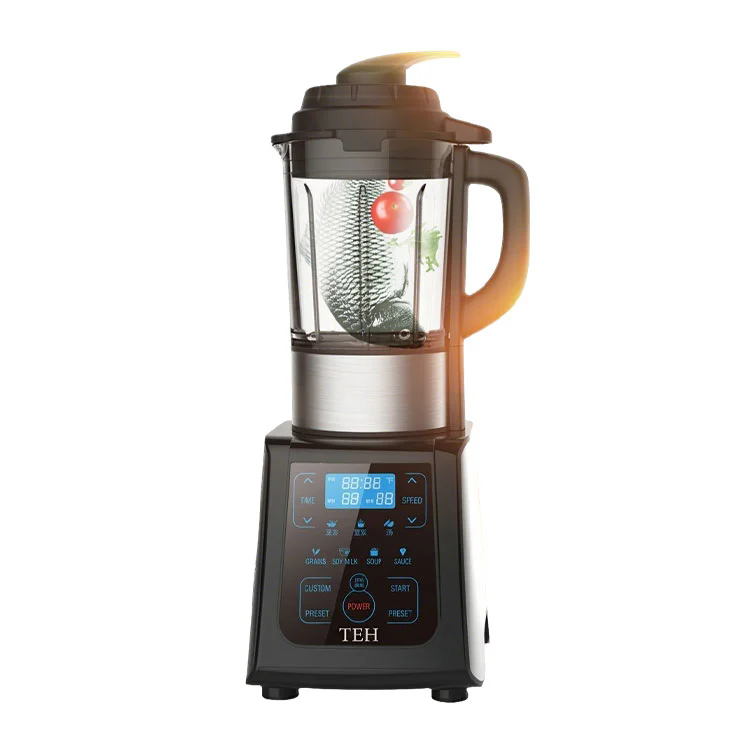
1. What Is the Difference Between Smooth and Chunky Texture Expectations?
The difference between smooth and chunky soup is not just the particle size. It is the mouthfeel, the appearance, and the release of flavor. A smooth soup has particles smaller than 0.5 mm. The texture is uniform, and the flavor is released evenly. A chunky soup has particles between 5 mm and 15 mm. The texture is varied, and the flavor is released as the pieces are chewed. The table below shows the particle size and sensory characteristics of different soup textures.
| Texture category | Particle size | Mouthfeel | Typical soup type |
| Velvety smooth | < 0.3 mm | Silky, uniform | Tomato bisque, pumpkin soup |
| Smooth | 0.3 – 0.8 mm | Thick, slightly grainy | Potato leek, broccoli |
| Rustic chunky | 5 – 10 mm | Varied, hearty | Minestrone, vegetable beef |
| Coarse chunky | 10 – 15 mm | Bite-sized pieces | Chicken noodle, lentil |
In our factory, we have tested the particle size distribution of soups made with different blending profiles. A single-speed High-Speed Blender produces a particle size of 0.2 to 0.5 mm, which is too fine for chunky soup. A low-speed stirrer produces a particle size of 8 to 15 mm, which is too coarse for smooth soup. The dual-mode design uses both: the high-speed mode for smooth, and the low-speed mode for chunky. Foshan TEH Electric Appliance Co., Ltd. has been manufacturing soup makers for over 10 years.
2. How Does the High-Speed Blender Achieve a Smooth Texture?
The high-speed mode uses a blade assembly that rotates at 18,000 to 22,000 RPM. The blade has four curved stainless steel blades that create a vortex in the soup. The vortex pulls the ingredients down into the blade, where they are cut and sheared. The high speed also creates cavitation, which further breaks down the particles. The key to a smooth texture is not just the speed but the duration. The blender runs in short pulses to prevent the motor from overheating and to allow the ingredients to circulate. The table below shows the blending parameters for different smoothness levels.
| Blending mode | Speed (RPM) | Pulse duration | Total blending time | Achievable particle size |
| Light smooth | 18,000 | 2 seconds on, 2 seconds off | 30 seconds | 0.5 – 0.8 mm |
| Standard smooth | 20,000 | 3 seconds on, 2 seconds off | 60 seconds | 0.3 – 0.5 mm |
| Extra smooth | 22,000 | 4 seconds on, 2 seconds off | 90 seconds | < 0.3 mm |
The high-speed mode is used after the ingredients have been cooked and softened. If the ingredients are still hard, the blade will not be able to break them down, and the motor may stall. In our factory, we program the soup maker to cook the ingredients first, then blend. The cooking time depends on the recipe and the ingredient size. TEH Electric Appliance provides a recipe book with recommended cooking and blending times for different soups.
3. How Does the Low-Speed Stirrer Preserve Chunky Texture?
The low-speed mode uses a different attachment: a stirrer or a paddle that rotates at 50 to 200 RPM. The stirrer does not cut the ingredients. It moves them gently to ensure even cooking and to prevent sticking. The low speed preserves the shape and size of the vegetables. The table below shows the stirring parameters for different chunky textures.
| Stirring mode | Speed (RPM) | Operation | Typical particle size | Best for |
| Gentle stir | 50 – 80 | Continuous | 12 – 15 mm | Minestrone, vegetable soup |
| Medium stir | 100 – 150 | Continuous | 8 – 12 mm | Lentil soup, bean soup |
| Active stir | 150 – 200 | Intermittent | 5 – 8 mm | Chicken noodle, tomato chunks |
Design consideration: The stirrer must be designed to avoid trapping ingredients between the paddle and the bowl. The paddle should have a rounded edge and a small clearance from the bowl wall (1 to 2 mm). If the clearance is too large, ingredients accumulate and burn. If the clearance is too small, the paddle scrapes the non-stick coating. In our factory, we use a clearance of 1.5 mm and a bowl with a smooth, rounded bottom.
4. How Does the Heating Program Support Both Textures?
The heating program must be different for smooth and chunky soups. For a smooth soup, the ingredients are cooked until they are soft enough to blend. The heating is intense and continuous. For a chunky soup, the ingredients are cooked until they are tender but not falling apart. The heating is gentler and may be interrupted by stirring cycles. The table below shows the heating profiles for the two texture modes.
| Heating parameter | Smooth mode | Chunky mode |
| Initial heating power | 1,000 W | 800 W |
| Heating duration | 15 – 20 minutes | 20 – 25 minutes |
| Stirring during heating | No (until blending) | Yes (every 3 minutes) |
| Final temperature | 95 – 100°C | 90 – 95°C |
| Blending after heating | Yes (high-speed pulses) | No (stir only) |
In our factory, we program the soup maker with two distinct heating profiles. The user selects the texture mode, and the appliance automatically adjusts the heating power, the stirring schedule, and the blending sequence. This ensures that the result matches the user's expectation. TEH Electric Appliance has validated these profiles through consumer testing with over 200 participants.
Frequently Asked Questions About Dual-Texture Soup Makers
Summary for Product Designers and Buyers
A dual-texture soup maker delivers smooth and chunky results by using two different mechanical actions: a High-Speed Blender for smooth textures and a low-speed stirrer for chunky textures. The heating program is also different for each mode, with higher power and longer cooking for smooth, and gentler heating with intermittent stirring for chunky. The user selects the mode, and the appliance automatically adjusts the parameters. By understanding the relationship between particle size, blending speed, and heating profile, designers can create an appliance that satisfies both preferences. Foshan TEH Electric Appliance Co., Ltd. has been manufacturing soup makers for over 10 years and provides full design and manufacturing support for our customers.
Foshan TEH Electric Appliance Co., Ltd. manufactures dual-texture soup makers with High-Speed Blender assemblies, low-speed stirrers, and programmable heating profiles. We provide recipe books, cleaning guides, and safety documentation for all of our products.