

How Planetary Mixer Achieves Uniform Mixing Through Planetary Motion?
2026-09-01
Before you read the technical explanation, ask yourself this: "Am I buying a mixer, or am I buying a solution to my mixing problem?" Most purchasing decisions fail because the buyer focuses on horsepower and capacity, while the real cost drivers are energy consumption, cleaning time, and batch consistency. This guide is written for procurement engineers who need to evaluate Planetary Mixer technology against their specific production requirements.
1. What Is Planetary Motion, and Why Should You Care?
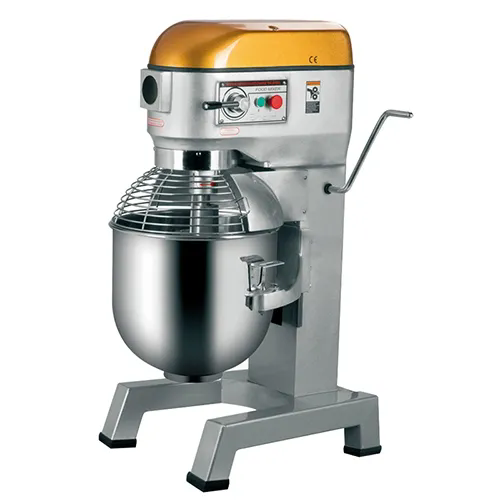
In simple terms, planetary motion means the mixing tool rotates around its own axis while simultaneously revolving around the center of the mixing bowl. This dual movement generates a velocity field that changes continuously across the vessel. The practical implication for your production is this: no material stays in a dead zone.
What this means for your purchase decision: If your current mixer leaves unmixed powder at the bottom corners, or if you have to stop the machine and scrape down the sides, planetary motion addresses those specific problems by design. You should verify that the mixer you are considering has a revolution to rotation ratio of at least 1:1.2. A lower ratio means less effective wall scraping.
In our factory, we manufacture Planetary Mixer units with a ratio of 1:1.4 for standard applications. This ratio is what allows the agitator to pass within 3 to 5 mm of the vessel wall, preventing material buildup. If a supplier cannot tell you their revolution to rotation ratio, that is a red flag.
2. How to Match a Planetary Mixer to Your Batch Size and Product Type?
This is where many procurement specifications go wrong. A mixer that is too large will waste energy and may not achieve proper mixing because the agitator cannot reach the material effectively. A mixer that is too small will require multiple batches, reducing throughput. The table below provides a reference for matching mixer capacity to typical food and chemical applications.
| Product category | Typical viscosity (cP) | Recommended batch size (L) | Mixer power (kW) | Typical mixing time (min) |
| Batters and slurries | 500 – 5,000 | 50 – 500 | 1.5 – 11 | 3 – 6 |
| Dough (bread, pizza) | 5,000 – 50,000 | 50 – 400 | 4 – 22 | 8 – 14 |
| High viscosity pastes | 50,000 – 200,000 | 30 – 200 | 7.5 – 37 | 12 – 20 |
| Chemical slurries | 100 – 1,000 | 100 – 1000 | 2.2 – 15 | 2 – 5 |
When evaluating a Planetary Mixer, ask the supplier for a mixing test report using your actual product. In our factory, we offer a free lab test where we run your sample material and provide a report on mixing time, temperature rise, and final homogeneity. This removes guesswork from your purchase decision.
3. What Are the Real Costs of Ownership You Need to Consider?
The purchase price is only the beginning. The true cost of a Planetary Mixer includes energy consumption, maintenance, and downtime for cleaning. The table below compares the long term costs of three common mixer types based on our factory's field data from food processing plants.
| Cost factor | Planetary Mixer (our design) | Horizontal ribbon mixer | High shear mixer |
| Initial purchase (for 200L batch) | Moderate | Lower | Higher |
| Average energy consumption (kWh/batch) | 2.8 | 3.2 | 4.5 |
| Cleaning time (minutes between batches) | 8 – 12 | 20 – 30 | 15 – 20 |
| Typical seal replacement interval | 3,000 hours | 2,000 hours | 1,500 hours |
| Average annual maintenance cost | $800 – 1,200 | $1,200 – 1,800 | $1,800 – 2,500 |
The cleaning time difference is particularly important. If you run two batches per hour, a mixer that takes 20 minutes to clean will idle for 6 hours per day. Over a year, that idle time adds up to 1,500 hours of lost production. Our Planetary Mixer is designed with smooth interior surfaces and removable agitator blades to reduce cleaning time to under 10 minutes.
4. How Do You Verify Mixing Uniformity Before Purchase?
Every supplier claims their mixer produces uniform results. Procurement engineers should demand objective evidence. The standard method is to take samples from different positions in the batch and measure a key property such as moisture content, salt concentration, or particle size distribution. The coefficient of variation (CV) should be below 5 percent for most food applications and below 3 percent for pharmaceutical products.
In our factory, we provide a mixing uniformity test report with every lab trial. The report includes sample locations, measurement data, and statistical analysis. We do not charge for this service because we believe you should only buy a Planetary Mixer after you have seen proof that it works for your specific product. If a supplier is reluctant to provide a test report, that is a strong signal to look elsewhere.
Frequently Asked Questions From Procurement Engineers
Summary for Procurement Decision Makers
Planetary motion is not a magic solution; it is a mechanical principle that addresses specific mixing challenges. The key to a successful purchase is to verify that the mixer's design matches your product properties and production schedule. Demand a lab test with your own material. Ask for energy consumption data. Understand the cleaning time and spare parts cost. With these data points, your decision becomes a calculated investment rather than a guess.
Ningbo Sybo Machinery Co., Ltd. supplies Planetary Mixer units to food, chemical, and pharmaceutical manufacturers worldwide. We provide full documentation including test reports, energy data, and maintenance schedules.