

Why Are High-Speed Blenders Essential for Smoothies and Shakes?
2026-10-08
A customer orders a green smoothie at a juice bar. The drink arrives with a gritty texture—tiny pieces of kale fiber and apple skin that coat the tongue. The customer sends it back. The owner checks the recipe: same ingredients, same proportions. The problem is not the recipe. It is the blender. A standard countertop blender produces a particle size distribution that ranges from 200 to 800 microns. The human tongue can detect particles as small as 20 microns. A High-Speed Blender reduces the particle size to 50 to 100 microns, which is below the threshold of most people's perception. This is why a high-speed blender is essential for smoothies and shakes. It is not about blending faster. It is about blending finer. This guide explains the physics behind particle size reduction and how to select a blender that delivers the texture your customers expect.
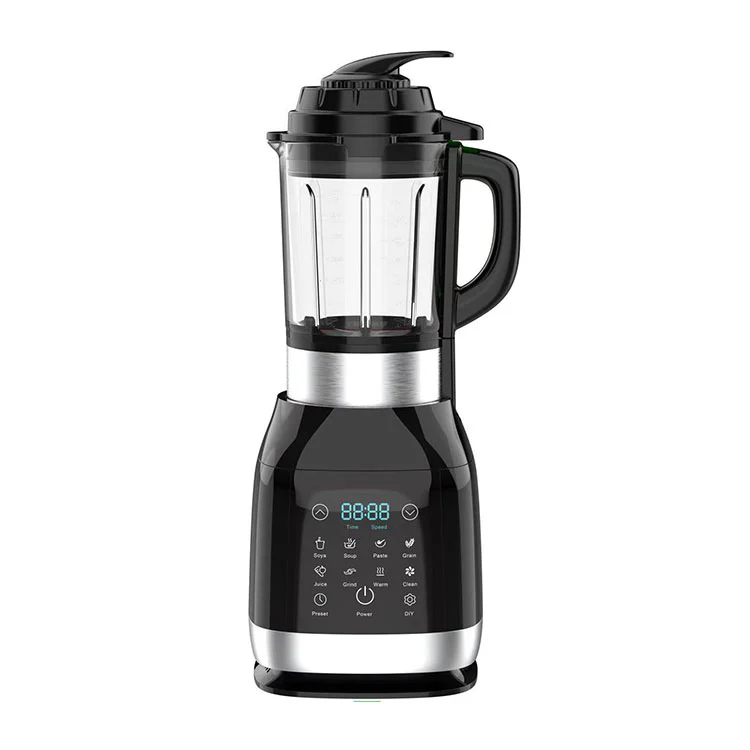
1. What Is the Relationship Between Blade Tip Speed and Particle Size Reduction?
The key parameter in blending is not the motor wattage. It is the blade tip speed. Blade tip speed is calculated by multiplying the blade radius by the rotational speed. A standard blender with a 50 mm blade radius operating at 20,000 RPM produces a tip speed of 105 meters per second. A High-Speed Blender with a 60 mm blade radius operating at 30,000 RPM produces a tip speed of 188 meters per second. The higher tip speed creates a more violent impact between the blade and the food particles. The table below shows the relationship between tip speed and particle size for common smoothie ingredients.
| Blender type | Blade radius (mm) | Speed (RPM) | Tip speed (m/s) | Particle size (microns) |
| Standard countertop | 50 | 20,000 | 105 | 200 – 800 |
| Mid-range | 55 | 25,000 | 144 | 100 – 400 |
| High-Speed Blender | 60 | 30,000 | 188 | 50 – 100 |
| Commercial high-speed | 65 | 38,000 | 259 | 30 – 60 |
In our factory, we measure the particle size distribution of smoothies made with different blenders using a laser diffraction particle size analyzer. The data confirms that the high-speed blender achieves a median particle size of 75 microns, which is below the 100 micron threshold that most consumers perceive as "smooth." Foshan TEH Electric Appliance Co., Ltd. has been manufacturing High-Speed Blender units for over 12 years and uses this data to optimize our blade designs.
2. How Does Vortex Formation Affect Blending Efficiency?
A High-Speed Blender creates a vortex in the blending jar. The vortex is a rotating column of liquid that pulls the ingredients down into the blade. Without a vortex, ingredients float on top of the blade and are not blended. The vortex is created by the combination of blade speed, jar shape, and blade geometry. A high-speed blender with a powerful motor can create a stable vortex that circulates the entire contents of the jar. A standard blender may not have enough power to create a vortex, which is why the ingredients stick to the sides. The table below shows the vortex characteristics for different blender types.
| Blender type | Vortex formation | Circulation pattern | Ingredient incorporation |
| Standard countertop | Weak or intermittent | Bottom only | Requires frequent scraping |
| Mid-range | Moderate | Bottom and middle | Occasional scraping |
| High-Speed Blender | Strong and stable | Full jar circulation | No scraping required |
| Commercial high-speed | Very strong | Full jar with folding action | No scraping; self-cleaning |
The strong vortex of a High-Speed Blender also creates a self-cleaning effect. The circulating liquid washes the sides of the jar as it rotates. This reduces the amount of material that sticks to the jar and makes cleanup faster. In our factory, we test the vortex formation of every blender model using a high-speed camera. We measure the vortex depth and the time required for complete ingredient incorporation. Our high-speed models achieve a vortex depth of 40 to 50 mm and incorporate all ingredients within 15 seconds.
3. How Do Different Ingredients Respond to High-Speed Blending?
Different ingredients have different levels of resistance to particle size reduction. Leafy greens like kale and spinach have tough cell walls that require high tip speed to break. Frozen fruit and ice require high torque to crush. Nuts and seeds require both high speed and sufficient time. The table below shows the blending response of common smoothie ingredients to high-speed blending.
| Ingredient | Resistance to blending | Time to reach 100 microns | Recommended tip speed |
| Banana | Low | 10 – 15 seconds | 100 – 150 m/s |
| Frozen berries | Moderate | 20 – 30 seconds | 150 – 200 m/s |
| Kale / spinach | High (fibrous) | 30 – 45 seconds | 180 – 220 m/s |
| Ice cubes | High (crystalline) | 20 – 40 seconds | 200 – 250 m/s |
| Almonds / seeds | Very high | 45 – 60 seconds | 220 – 260 m/s |
The data shows that a High-Speed Blender with a tip speed of 180 to 200 meters per second can handle most smoothie ingredients within 45 seconds. For tougher ingredients like almonds or ice, a commercial high-speed blender with a tip speed above 220 meters per second is recommended. In our factory, we provide a blending guide with every High-Speed Blender that lists the recommended time and speed for common ingredients.
4. What Are the Motor and Bearing Requirements for High-Speed Blending?
The motor and bearings are the components that enable high tip speed and sustained operation. The motor must deliver high torque at high speed. A universal motor with a power rating of 1,200 to 1,500 watts is typical for a High-Speed Blender. The bearings must handle the radial and axial loads imposed by the rotating blade. We use sealed ball bearings with a rated life of 2,000 hours. The table below shows the motor and bearing specifications for our high-speed models.
| Component | Specification | Typical value |
| Motor type | Universal motor with variable speed | 1,200 – 1,500 W |
| Maximum speed | No-load speed | 30,000 – 38,000 RPM |
| Bearing type | Sealed ball bearing | 6002 or 6003 |
| Bearing life | L10 life at rated load | 2,000 hours |
| Overheat protection | Thermal cutout | 120°C |
| Duty cycle | Continuous with cooling fan | 10 minutes on / 2 minutes off |
Selection tip: When choosing a High-Speed Blender for smoothies and shakes, look for a motor with at least 1,200 watts and a blade tip speed of at least 180 meters per second. A variable speed control allows you to start slow and increase speed gradually, which prevents the ingredients from flying up the sides of the jar. Our factory offers a range of models with these specifications.
Frequently Asked Questions About High-Speed Blenders for Smoothies and Shakes
Summary for Beverage Developers and Home Users
A High-Speed Blender is essential for smoothies and shakes because it reduces particle size below the threshold of perception, creates a strong vortex for complete circulation, and handles tough ingredients like kale and ice. The key parameters are blade tip speed, motor power, and bearing quality. A blender with a tip speed of 180 to 200 meters per second and a motor of 1,200 to 1,500 watts is sufficient for most applications. For commercial use, a higher tip speed and a longer duty cycle are recommended. Foshan TEH Electric Appliance Co., Ltd. has been manufacturing High-Speed Blender units for over 12 years and supplies to juice bars, restaurants, and home users worldwide.
Foshan TEH Electric Appliance Co., Ltd. manufactures High-Speed Blender units with variable speed control, sealed ball bearings, and thermal protection. We provide blending guides and particle size data for all of our models.